August 6, 2022
In the summer of 2018, I finally figured out what to do with the Adams Trail-a-bike I had from when the kids were little. I’d actually tried to give it away and no one seemed to want it. I have long been envious of folks with cargo bikes and had I had the means when we just started with kids, I’d have got a cargo bike. As it was, I found the trail-a-bike on craigslist and that was fun for the kids when they fit it. As they grew and it sat and gathered dust, I started trying to think about ways to use the trailer.
The final inspiration came when my eldest was taking an hour bus ride to and from summer school with a Baritone Saxophone. I thought, it’s a 20min bicycle ride, why not figure out how to bring the saxophone along on the bike. This is when I seriously started trying to figure out how to make a cargo trailer out of a trail-a-bike. The overall design was inspired by the cargo bikes I’ve seen around.
The basic design is pretty straight forward, like most cargo bikes it needs a long rack. I didn’t know how long but longer than a standard off the shelf bicycle rack. In doing the research for this I found this guy (Paul Woloshansky), who had made his own racks, front and back for a bicycle out of 1″ x 1/8″ 316 stainless steel bar stock. I found 304 and it has served it’s purpose admirably since construction.
The second thing I thought I’d need was some kind of shelf or rack below to hold things up. I’d seen cargo bikes with lower “shelves” or tubing for kids to put their feet on and for panniers to rest on or strap to. As I thought about it I figured the shelves should be retractable so when not using one side or either side they could be out of the way. In the end I opted for pvc piping as it’s light, waterproof, relatively inexpensive (the joints were more than expected I have to admit) and easy to work with.
There are a few reasons I like this idea of the trail-a-bike cargo trailer. One is weight distribution, another is reduced friction, and the last thought is flexibility. The trail-a-bike attaches to the bicycle that’s towing it, in the middle. It attaches to the bicycle seat post. So any weight on the tongue of the trailer will come down where the bicycle is designed to carry it. This distributes the tongue weight between the two wheels. This seems like an advantage to me. After looking into this, it’s not as big a deal if the load is distributed properly over the axle of the trailer, if not it could still be an issue as most bicycle trailers attach to the rear wheel forks which puts all the tongue weight on the rear tire. As for reduced friction, the single wheel on the ground carrying the weight of the trailer is great, it’s half the friction of a two wheeled trailer. One disadvantage of this is requiring the load to be reasonably balanced on the single wheel or you get dragged into traffic or off the road depending on where the imbalance takes you. Finally it’s flexible because I don’t have to ride a cargo bike everywhere, for tootling around or trying to get some exercise I don’t necessarily want to carry around all that extra bicycle.
Construction took place over a few weekends and involved help from a friend of mine who is a welder. I tried to keep welds to a minimum and I’ll suggest alternates as I come to the parts that are welded. The goal was to preserve the trail-a-bike if we ever wanted to convert it back. So the trailer hasn’t been permanently altered from the original configuration for that purpose. For example I still have the seat and post, and the crank if I ever want to put it back. The main rack is bolted together, the pvc is bolted on as well after it was glued together.
The final cost of the project over all was about $100.00 which is more than I expected but is still significantly lower than a new cargo bike or even purchasing a bicycle trailer. The majority of the cost was in the pvc joints. I don’t see a way around this but if you can do better please let me know in the comments below.
We started with the rack. This started as a single piece of stainless steel bar stock (1″ x 1/8″ x 12′). After measuring a bunch and debating where it should end (at the end of the tire or past it or over the axle of the wheel?), we decided to end the rack just past the axle of the wheel of the bicycle.

The full distance the rack goes from front attachment point (a welded T junction attached with the screws for the bottle holder) to the back is about 30″. The width of the rack is about 7″. The brackets at the back are ~13″ after twisting to improve strength. Each strap going across the top of the rack is about 9″ long before bending.
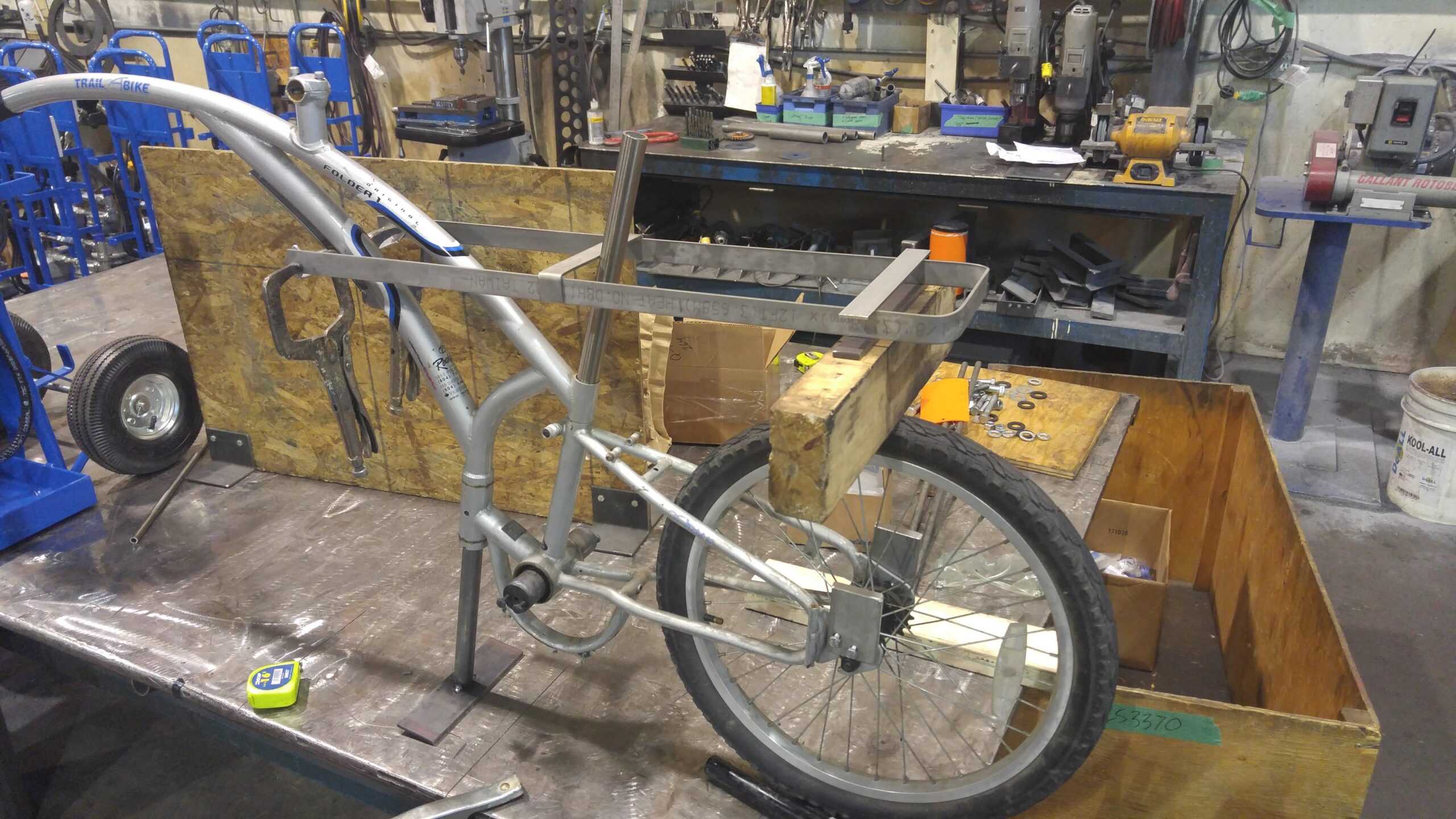
Everything was cut and dry fitted before drilling holes, welding or bolting anything on. You can see below that we’ve added a piece of pipe in the crank with ends welded on, a post where the seat post was and metal blocks bolted on where traditional rack and fender would attach. This last was to add bolt holes for the straps coming down. Additional holes will be needed for the shelf at the bottom, the holes in the pipe ends were threaded as were any of the new holes in the block at the back.


With respect to replacing welds that we did, you could cut the tabs in the front of the rack frame long and bend/twist them in to overlap one or other of the bolt holes for the bottle holder and then find a long bolt with the right thread to trap the 2 ends together on the front of the trail-a-bike. The piece in the crank could be a solid piece of wood… it would need finishing or replacing (or both) over time, but it could be made to be tight. The pipe piece is loose which causes a bit of trouble occasionally. The seat post could also be wood and a screw or bolt could go through the top strap into the post to make it secure. Again requiring finishing and/or replacing in wet environments. You could try and do something clever with a bike seat post and possibly a deconstructed bicycle seat or bolt in a piece of metal strap across the top to put a hole in and put in a screw or bolt through the cross strap for the rack.
In our case my friend the welder welded the strap to the piece of stainless pipe we cut to hold the strap over the seat post. We drilled the holes and bolted all together.


Next was getting the shelves together for the bottom part of the cargo rack. Again dry fitted before gluing or fixing together. These were made to be about 30″, the same length as the rack itself. They were made to be 12″ wide. This seemed to be a good size, not really expanding the width of the bike unreasonably and at the same time providing enough surface to carry quite a lot of stuff it turns out.


All of the parts for the shelves on the bottom are 1/2″ PVC piping with the exception of the T-joints used as hinges/hanging points. These are 3/4″ which works perfectly as a hinge if you don’t glue it together. Note the lengths of pipe for the hinges was deliberately kept short to trap the hinge and prevent forward and back movement while loaded.
The hangers as a result are 3/4″ PVC pipe cut to length with one end heated and flattened to provide a surface to bolt through. These were cut to carry the shelves 6″ from the ground. This is sufficient for road riding. I don’t think I’d be pulling a trailer on a trail.


The line used here was originally intended just as part of the dry fitting and not to be a permanent part of the trailer. I’d originally intended to do something cool with a bit of chain or something but the flexibility of having lines tied to the rack was too much to pass up. This is the solution I ended up going with in the end. This horrible nylon line is cheap and is surprisingly durable (4 yrs and still going strong).
Now to test the thing out. I use this trailer to this day to go grocery shopping. It’s a nice long ride to the main grocery store I shop at and this trailer can carry a whole load which I didn’t originally expect.


So initial tests with full grocery loads were successful, however the gaps in the bottom let the soft bags I was using droop down on to the road if they weren’t loaded just right. I lost a bag and some food at one point when the bag wore through on the ground and dropped it’s load in the middle of an intersection. That was a tiny bit disappointing. So I looked around and found this instructable. The cleverness of this can’t be overstated, this is an awesome use for old bicycle inner tubes. If you don’t think you have enough of this material handy to make a mat like this you can go by your local bicycle shop (as I did) and pick up a bunch of innertubes for free (they were happy to get rid of them). In this case I used zap straps to tie this mat to the frame of the shelf. Overall this solution is working well for keeping things from falling through the bottom of the shelves.


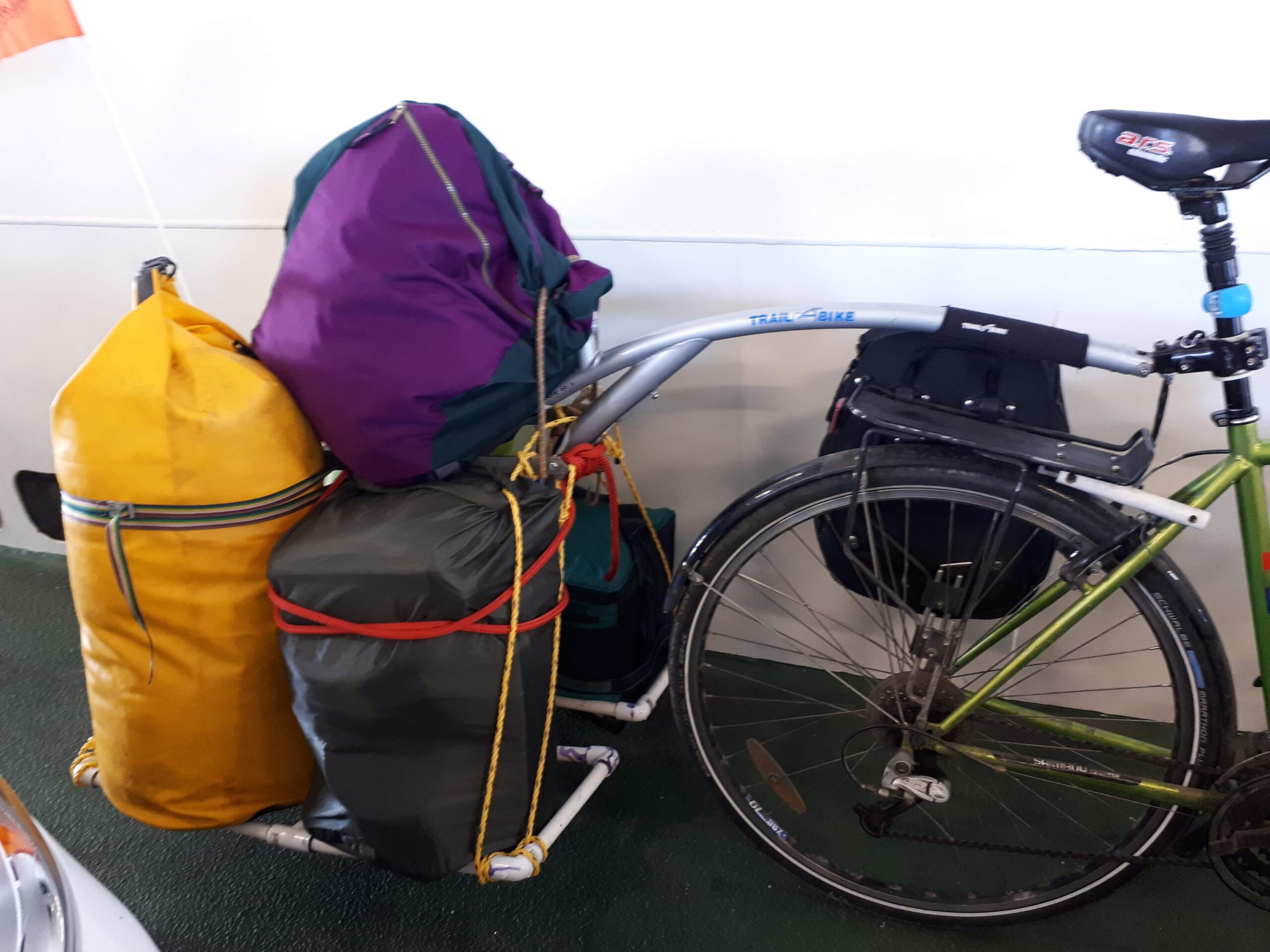
Once I had the working trailer, NOW I wanted to test carrying capacity. I had also had it in my head that having this trailer would mean going camping on a bicycle. Hopefully to the islands, since I’m living on the west coast of Canada and really want to get out to the islands more often. The cost of ferries for a car is too high but the cost of walking a loaded bicycle onto the ferries is much more reasonable. I even talked my kids into coming with me. It was an epic trip if I do say so myself. These pictures are of the bicycle on the ferry fully loaded.


By fully loaded I mean, food, tents, cooking gear for 4 days for 1 adult and 2 teenagers. I believe I was carrying more than 100lbs on the trailer on the way out. I admit I didn’t pick it all up and weigh it but I can tell you there were a few hills where I simply got off and walked the bike and trailer up rather than wobble out into traffic while struggling to pull the weight up the hill.
Modifications under consideration:
- The pipe in the crank needs to be attached to the bike. We welded a tab onto it which matches to a bolt hole handy on the one side of the crank, however this needs lock tite or something to keep the bolt from shaking free.
- Shielding between the rack and the wheel. The soft bags I use for groceries can end up rubbing on the tire or getting into the spokes of the wheel if I’m not careful as I load the bags on the bike. Thinking about it now I might look into running more line between the forks for the wheel and the rack to prevent the soft bags from falling into the tire. The other option here is to build or buy paniers. This looks interesting, I could do something with these based on my final dimensions.
- I’d like to figure out a retractable stand for the trailer. Loading it without support can be quite frustrating with significant weight. Maybe something coming out the bottom of the post near the front on the bottom of the frame, that folds up out of the way when not in use but which is easy to kick down when wanting to load it. It would have to be substantial enough (or splayed far enough apart?) to support the weight of the bike and some significant weight loaded on one side.
